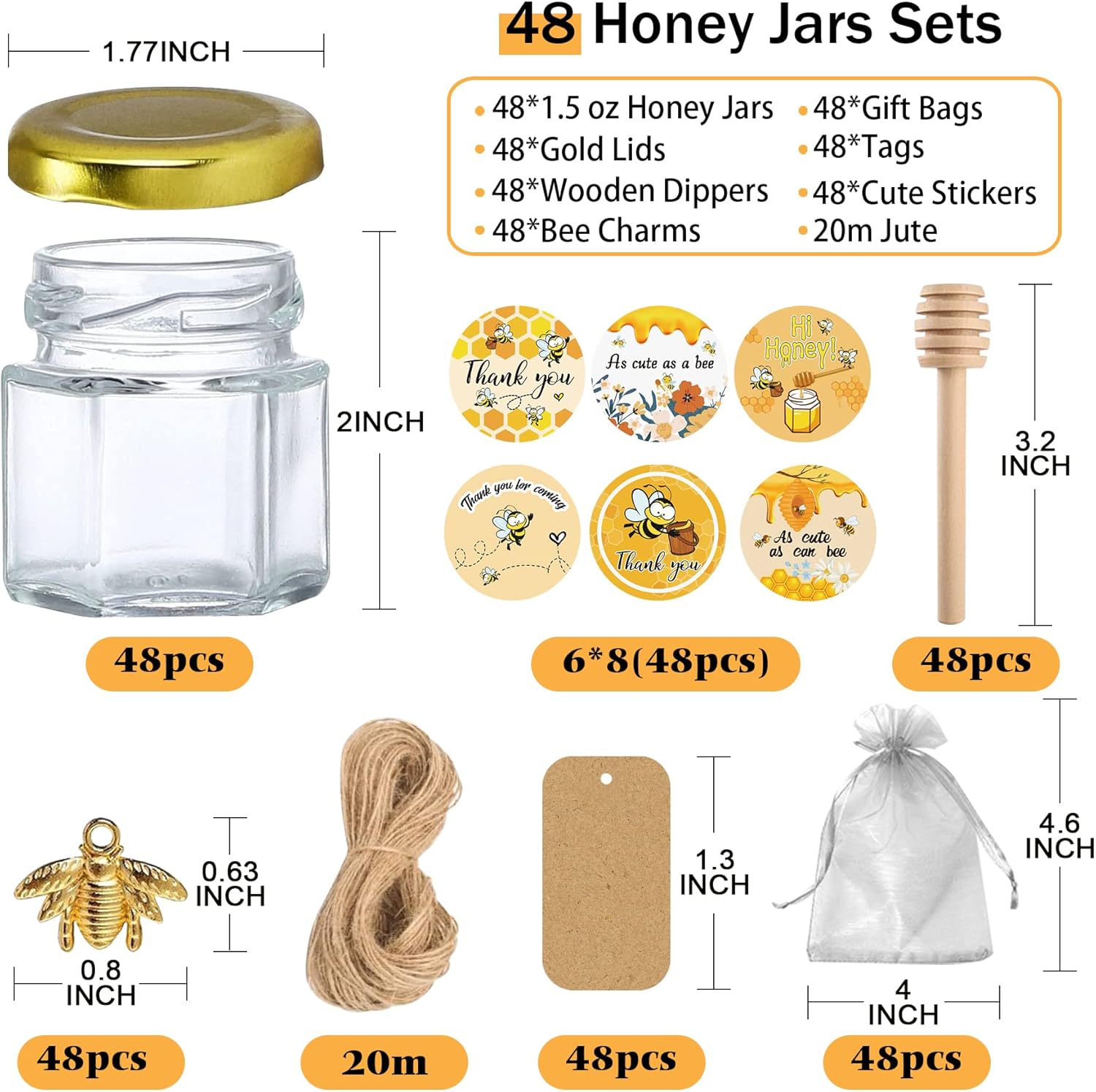
If you’ve been to a wedding in the last few years, you’ve probably seen them: small glass jars, no bigger than your thumb, filled with golden honey and tied with a ribbon or a tiny wooden dipper. These are mini honey jar favors — a single-serving portion of real honey (usually one to two ounces) packaged as a take-home gift for each guest. Unlike a lot of reception favors that end up in a banquet hall trash can by midnight, honey is shelf-stable, universally edible, and feels genuinely useful — which is why guests tend to slip it into a pocket or purse the moment they spot it. This guide is written for the planner or couple who has already decided honey jars are in the running and now needs to make the actual call: which size, which supplier tier, what the label situation costs, and whether the math holds up across different headcounts. We’ll walk through every meaningful decision point so you can close this line item with confidence.
| EDITOR'S PICKTecUnite 100 Pack 2 Ounce Metal… | Mid-tier[Ritayedet 40 Pack Glass Favor J…](https://www.amazon.com/dp/B08FBW5H9Y?tag=greenflower20-20) | Budget pick[Foraineam 40 Pack 2 Ounce Round…](https://www.amazon.com/dp/B08DCR4CDK?tag=greenflower20-20) | |
|---|---|---|---|
| Capacity | 2 oz | 3.4 oz | 2 oz |
| Material | Metal | Glass | Metal |
| Lid type | Clear lid | Cork lid | Clear screw top |
| Quantity | 100 | 40 | 40 |
| Twine/labels incl. | — | ✓ | — |
| Price | $52.99 | $27.99 | $27.99 |
| See on Amazon → | See on Amazon → | See on Amazon → |
Why Honey Favors Survive the Favor Table (and Most Others Don’t)
The “kept vs. abandoned” split is a real planning problem. The Knot’s annual wedding favor survey consistently ranks edible favors among the top categories guests actually take home, and honey sits near the top of that list because it clears every practical objection at once: it doesn’t spoil, it has no common allergens that would sideline a large percentage of guests (unlike nut-based favors), it travels without refrigeration, and it reads as a premium product even at modest price points.
Martha Stewart Weddings has featured honey jar favors repeatedly in its rustic, garden, and cottagecore coverage, noting that the jar itself — when chosen well — functions as a small decorative object that guests display on a kitchen shelf rather than discarding. That secondary life is meaningful: it means your favor stays in someone’s home for weeks or months, functioning as a soft brand impression of your event.
Style Me Pretty’s roundups of favors-as-décor consistently flag honey jars as one of the few categories where the display arrangement on a favor table or escort card display can rival a floral installation in visual warmth, especially in amber-toned, golden-hour, or botanical wedding aesthetics.
The tradeoff you accept when you go this route: honey favors are heavier than paper or seed-packet favors, which matters if guests are traveling, and they require more lead time than a generic order because the custom label — the piece that makes the favor feel personal rather than generic — is where most of the production timeline lives.
Sizing and Pricing: The Math You Actually Need
Mini honey jar favors come in three practical sizes: 1 oz, 1.5 oz, and 2 oz. There’s a meaningful difference in what each size signals to a guest and what it costs you at scale.
By the numbers (2026 market rates, US domestic suppliers):
| Jar Size | Typical Per-Unit Range (labeled, ready to display) | Guest Perception |
|---|---|---|
| 1 oz | $3.50 – $6.00 | Petite / favor-forward |
| 1.5 oz | $5.00 – $8.50 | Standard / balanced |
| 2 oz | $6.50 – $11.00 | Generous / centerpiece-worthy |
These ranges assume a custom label (name, date, short tagline) ordered through a mid-tier Etsy artisan or a specialty favor supplier. At the entry level — plain kraft label, no foil, digital print — you’re near the floor. Letterpress, foil-stamp, or hand-applied wax seal labels push you toward the ceiling and sometimes past it.
Brides’ coverage of edible wedding favors notes that the per-unit sweet spot for most couples with 100–150 guests lands around the 1.5 oz jar with a digitally printed custom label, which keeps the per-guest cost in the $6–$8 range and stays well within the $10–$25 favor budget that represents the largest segment of reception gifting decisions.
If your headcount is above 200: the per-unit cost often drops when you order through a wholesale honey supplier and source labels separately. The DIY label route — buying blank jars, local or bulk honey, and having labels printed through a stationery shop — can bring per-unit cost down to $3.50–$5.00, but it adds 3–6 hours of assembly labor and requires a reliable honey source that meets your quantity with a single consistent varietal. Don’t underestimate the coordination cost of that approach.
Label Strategy: Where Personalization Earns or Wastes Money
The label is the favor’s personality. A plain white sticker with your names and date is functional but forgettable. A well-designed label that matches your invitation suite or wedding color palette turns a $5 honey jar into a $9 honey jar in the guest’s perceived value — which is almost always worth the incremental cost.
Three label tiers to evaluate:
Digital print on kraft or white stock — The workhorse option. Fast turnaround (typically 5–10 business days once files are approved), lowest cost, widely available through Etsy artisan shops and specialty favor suppliers. Suitable for most weddings. Quality varies significantly by printer, so request a physical proof before approving a full run.
Foil-stamp or letterpress labels — Adds tactile quality that guests notice when they pick the jar up. Costs $0.75–$2.00 more per unit. Lead time jumps to 3–5 weeks in most cases. Town & Country’s 2025 luxury wedding favor coverage specifically calls out foil-label honey jars as one of the few sub-$15 favors that read as premium to guests who would ordinarily notice a “budget” favor. Worth it if your aesthetic is formal, maximalist, or high-gloss.
Hand-calligraphed tags — A ribbon-tied hang tag in hand-calligraphy is the most labor-intensive option and the most photogenic. It pairs well with a raffia tie or dried botanical accent. Realistically priced at $2.50–$4.00 per tag when sourced through a calligraphy artist, plus the cost of the ribbon and any botanical additions. This approach is genuinely beautiful at a styled micro-wedding of 40–60 guests; it gets expensive and logistically complicated above 100.
The Knot’s favor planning guides emphasize one often-overlooked detail: label adhesion to glass. Honey jars sweat slightly in humid environments (outdoor summer receptions, especially). Request a supplier that uses permanent waterproof adhesive on glass, not standard paper-label adhesive. This is a small spec question that separates experienced favor suppliers from novice ones.
Sourcing Tiers: From Etsy Artisan to Specialty Wholesaler
Your sourcing decision is essentially a tradeoff between price, customization quality, and production reliability. Here’s how the tiers break down in 2026:
Etsy artisan suppliers ($5–$11/unit, MOQ typically 24–50 units): The dominant sourcing channel for under-200-guest events. Quality is highly variable — this is a category where the difference between a five-star shop with 2,000 reviews and a newer listing with 40 reviews can be significant in terms of label registration, jar quality, and shipping integrity. Aggregated reviews on top-performing Etsy honey favor shops consistently flag the following as signals of a reliable seller: response time under 24 hours, physical proof offered before full run approval, and glass-jar (not plastic) standard construction. Plastic honey jars are cheaper but read as lower quality and don’t photograph as well — something that matters given how extensively favors appear in wedding photography.
Specialty favor wholesalers (e.g., Beau-coup, WeddingFavorsUnlimited, comparable suppliers): Mid-tier pricing, often lower per-unit than Etsy at quantities above 100, with more standardized label templates. Less bespoke but more operationally predictable. Good choice when you’re managing a high-headcount event and need to minimize coordination variables.
Local apiary partnerships: An underutilized option that adds a genuine provenance story to the favor. Many regional apiaries sell wholesale in case quantities and will accommodate a custom label run if you bring your own label files. The honey quality is typically higher than mass-supplier honey, and the local sourcing narrative is meaningful for couples with a farm-to-table or sustainability aesthetic. Style Me Pretty’s roundups of “favor stories” — the narrative couples share on signage or in menus — consistently show local-honey sourcing as one of the most resonant origin stories a favor can carry. Lead time is longer because you’re coordinating two vendors (honey source + label printer), but the output is hard to replicate at scale.
Luxury tier ($15–$25+/unit, bespoke suppliers): For events where the favor is a genuine gift rather than a token, some bespoke suppliers offer raw varietal honey (single-origin wildflower, sourwood, tupelo) in hand-blown or embossed glass jars with premium foil labels and gift-boxed presentation. This tier is most relevant for intimate weddings under 75 guests, VIP corporate gifting, or welcome amenity suites at destination events. The per-unit cost is high, but the category legitimately earns its price point in perceived value.
Lead Times, Minimums, and the Decisions You Can’t Delay
If there’s a single mistake that experienced planners cite most often with honey favor orders, it’s underestimating label production time. The honey itself is rarely the bottleneck — it’s the custom label that takes longest and has the most revision cycles.
Practical timeline benchmarks for 2026:
- Digital print label, Etsy artisan, 50–150 units: 2–3 weeks from artwork approval to delivery. Allow an extra week for proof review.
- Foil or letterpress label, specialty printer: 4–6 weeks minimum. Some premium suppliers are booking 8 weeks out during peak spring and fall wedding seasons.
- Local apiary + separate label printer: 5–7 weeks when coordinating two independent vendors.
- Rush fees: Most suppliers offer rush production at a 20–35% surcharge. This is a meaningful cost to factor into your budget if you’re starting the process late.
Minimum order quantities (MOQs) are the other lever. Most Etsy suppliers start at 24 or 36 units — sensible for micro-weddings but not an issue for larger events. Wholesale suppliers often have MOQs of 100–144 units, which can require a headcount commitment before your final RSVP numbers are confirmed. The standard workaround: order to your estimated guest count plus 8–10% overage. Honey jars don’t expire quickly (most raw honey is shelf-stable for 2+ years), so overage isn’t waste — it’s inventory for personal use or gifting.
The Decision Rule
If your guest count is under 80 and your budget is $7–$11 per favor, a 1.5 oz jar from a well-reviewed Etsy artisan with a foil or quality digital label is the clearest call. The category earns its per-unit cost in kept-rate and aesthetic impact.
If your guest count is 100–200 and you need to hold $5–$7 per favor, a specialty wholesaler with a digital label and a single clean design will hit the number. Upgrade the label if your budget allows even $0.75/unit more.
If your event is small and premium — 30–60 guests, $15+ per favor available — source from a local apiary, specify a single-origin varietal, and invest in the label presentation. This is the tier where honey favors genuinely compete with gift-level keepsakes, not just reception tokens.
The one condition under which honey jars are the wrong call: if more than 15% of your guest list is traveling internationally with strict customs rules about honey imports (common with destination weddings in Europe or Australia), the favor creates a logistical burden for guests that undercuts the goodwill it’s meant to generate. In that case, redirect the budget to a locally sourced consumable at the destination.
Every other scenario? Honey jars are a safe, scalable, high-kept-rate favor that punches above their price point — and yes, guests really do open them in the parking lot.