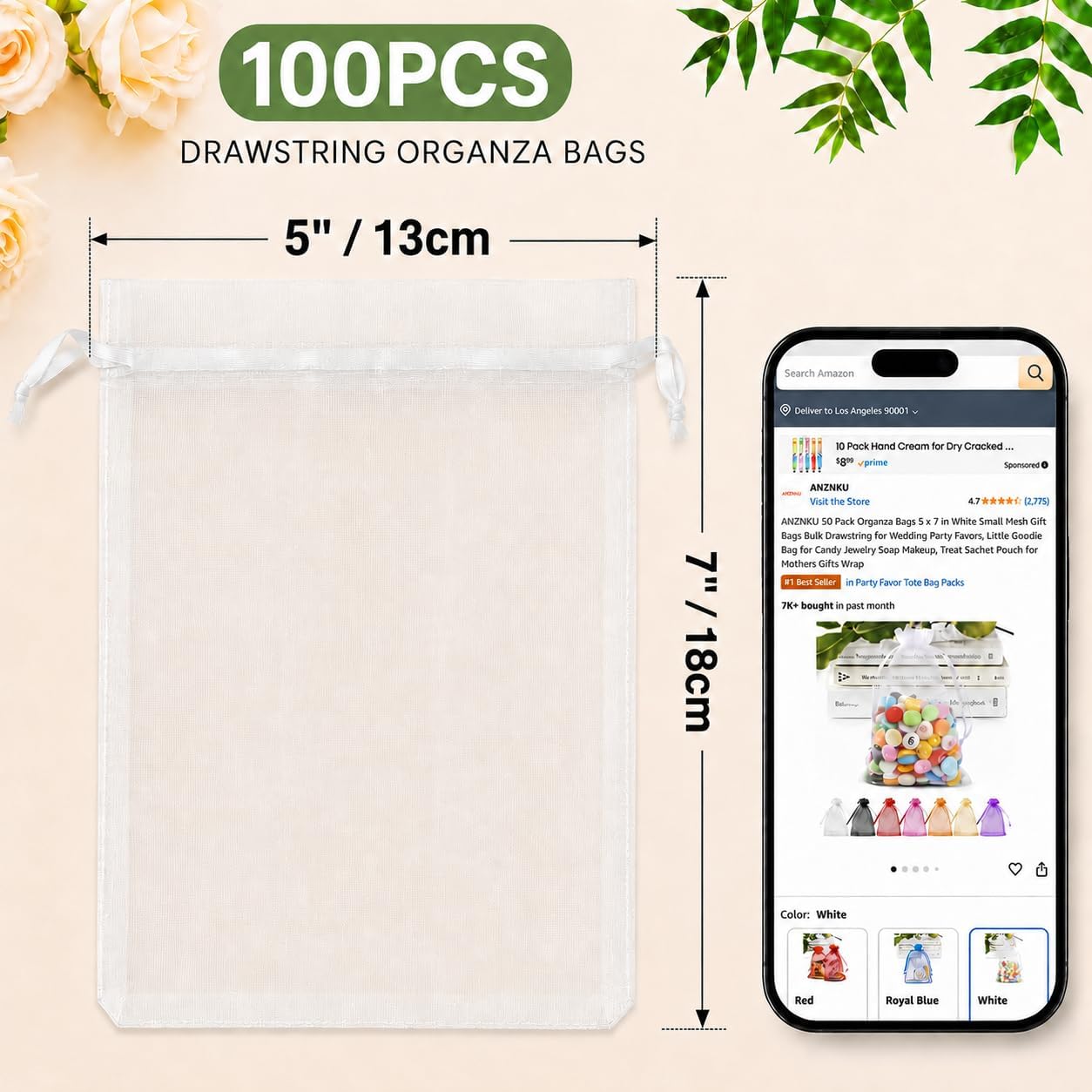
If you’ve ever ordered favors you loved — a small tin of honey, a packet of wildflower seeds, a bar of artisan soap — and then watched them sit ignored on a gift table, the problem usually wasn’t the favor. It was the presentation. Packaging is the first thing a guest sees, and it does a disproportionate amount of emotional work. An organza bag, for example, is a small pouch made from sheer, lightweight fabric — typically used to hold and display a single favor or small grouping. When done well, packaging signals care and intentionality before the gift is even opened. When it’s an afterthought — a bare item lying on a table, or worse, stuffed into a plain plastic bag — even a $6 favor reads as cheap. This guide is for planners who already understand the basics and want a clear framework for choosing packaging that earns its cost.
Why Packaging Has Outsized ROI at Every Budget Tier
The math is straightforward but counterintuitive: packaging often delivers more perceived-value lift per dollar than the favor itself. A $1.50 organza bag with satin ribbon tied around a $2.50 candle reads as a $9–$12 favor to most guests. Swap the organza bag for nothing — just the candle on a table — and the same item reads as a $3 favor. That’s not a small difference; it’s the gap between “thoughtful gesture” and “obligation item.”
The Knot’s annual wedding favor research consistently notes that guests are far more likely to take a favor home when it’s packaged as a discrete, gift-wrapped item rather than displayed loose. This aligns with what event planners describe anecdotally: packaged favors have a much lower abandonment rate on tables at the end of the night.
This matters at every tier, but the mechanism differs:
- Budget tier ($1–$5/guest favor): Packaging is doing the heaviest lifting. The favor itself is modest; the packaging is the primary vehicle for perceived value.
- Mid-tier ($15–$40/guest favor): Packaging becomes a brand-alignment exercise. The favor is good enough to stand on its own; the packaging needs to match, not undercut it.
- Luxury tier ($75+/guest favor): Packaging is expected to match the favor’s quality. A hand-poured candle from Voluspa shipped in a thin organza bag reads as a mismatch. Here, rigid boxes, tissue, and custom labels earn their premium.
The Packaging Hierarchy: Materials, Formats, and When to Use Each
Not all packaging formats serve the same purpose. Here’s how to think through your options based on what you’re wrapping and what effect you’re after.
Organza Bags
Organza bags are the most widely used favor packaging format at the budget and mid-tier levels, and for good reason: they’re inexpensive in bulk (typically $0.15–$0.45 per unit at 100+ quantities), they’re reusable so guests feel less guilt keeping them, and the sheer fabric lets the favor show through — which is a form of visual honesty that guests respond to positively. They work best with:
- Candies, chocolates, or bath salts (the contents create visual texture)
- Items with a natural or organic aesthetic (seed packets, dried herbs, small stones)
- Favors where you want the item itself to be the focal point
The tradeoff: organza bags read as “classic wedding” and may feel dated at more editorial, design-forward events. If your aesthetic is industrial, modern minimalist, or high-fashion, organza can pull your tablescape in the wrong direction.
Sizing decisions matter more than most buyers anticipate. A bag that’s too large for its contents looks deflated and cheap. A bag that fits snugly and holds its shape reads as considered. Martha Stewart Weddings’ packaging guidance consistently emphasizes sizing as the single most impactful variable in organza bag presentation — before color, before ribbon, before tag.
Kraft and Rigid Boxes
Kraft paper boxes (small folding cartons) and rigid setup boxes occupy the mid-tier packaging space. Kraft boxes, particularly window-cut styles that reveal the contents, are a favorite in the sustainable-aesthetic segment — they photograph well, align with eco-conscious event branding, and accommodate a wider range of favor shapes than bags. Per-unit cost at moderate quantities runs roughly $0.45–$1.20 depending on construction complexity.
Rigid boxes — the kind with a separate lid — are the packaging format of choice at the luxury tier. They hold their shape, stack cleanly for display, and feel substantial in the hand. The tactile experience of lifting a lid matters for premium favors; it creates a small moment of ceremony. The cost reflects this: rigid custom boxes typically run $1.50–$4.00+ per unit at luxury minimum quantities, and lead times (discussed below) are longer.
Custom Printed Bags and Pouches
Cotton muslin bags with custom printing or heat-transfer monograms have grown significantly in the 2024–2026 event market, per reporting from Town & Country Magazine’s coverage of evolving event gifting trends. They bridge the organic-aesthetic of organza with greater durability and a cleaner canvas for personalization. A printed muslin bag with a couple’s monogram and date is a favor in itself — guests keep the bag long after the contents are gone.
The cost differential is meaningful: custom-printed muslin bags at 100-unit quantities typically run $1.80–$3.50/unit, versus $0.20–$0.45 for unbranded organza. That’s a real per-guest cost decision, not a rounding error.
By the Numbers
| Packaging Format | Per-Unit Cost (100+ qty) | Best Favor Pairing | Lead Time |
|---|---|---|---|
| Organza bag (standard) | $0.15–$0.45 | Candies, small bath items | 3–7 days |
| Kraft window box | $0.45–$1.20 | Candles, soaps, baked goods | 5–10 days |
| Custom muslin bag | $1.80–$3.50 | Seeds, sachets, small keepsakes | 10–21 days |
| Rigid gift box (custom) | $1.50–$4.00+ | Luxury candles, crystal items | 3–6 weeks |
The Details That Actually Change Perception
Choosing the right packaging format is the foundation. The finishing details are where budget events consistently outperform expectations — or where mid-tier events get undercut by sloppy execution.
Ribbon and Closure
A satin ribbon tied in a clean bow adds approximately $0.05–$0.15 per favor and is consistently cited in Brides’ favor planning guides as the easiest single upgrade for perceived value. The key is consistency: ribbon bows tied at slightly different heights or tightnesses read as unfinished at scale. If you’re assembling 150+ favors, make a simple jig (a piece of cardboard cut to a consistent width) to standardize bow placement. This is the kind of detail that separates events that photograph well from events that don’t.
Alternatives to ribbon that are trending in 2026: bakers twine for rustic/organic aesthetics, wax seals on folded tissue inside boxes, and heat-shrink wrapping for geometric modern aesthetics.
Custom Tags and Labels
A hang tag or sticker label with the couple’s name, date, or a short message is the cheapest personalization available — often $0.08–$0.20 per unit when ordered through digital printing services. The ROI on this is hard to overstate. Per reporting in Martha Stewart Weddings’ favor packaging coverage, personalized labeling is the single factor guests most associate with “thoughtfulness” in post-event surveys — more than the favor’s monetary value.
The practical decision: printed labels are faster and cheaper; die-cut hang tags with custom shapes feel more premium. For budget-tier packaging, labels do the job. For mid-tier and above, hang tags add a tactile dimension that labels can’t match.
Color Alignment to Event Palette
This sounds obvious but is frequently underexecuted. Organza bags and ribbon should be chosen from the event’s actual color palette — not just “neutral” or “white” as a default. Off-white organza at a warm ivory event reads as color-mismatched to attentive guests. Dusty rose ribbon at an event with cool mauve tones creates the same subtle discord.
Most packaging suppliers offer substantial color ranges, and the cost difference between “white” and a specific Pantone-adjacent color is typically zero at standard quantities. This is a free upgrade that most buyers don’t take because it requires an extra decision. Take the decision.
Lead Times: The Risk That Catches Planners Off Guard
Standard organza bags are a commodity — you can have them in 3–7 days from most domestic suppliers. Custom packaging with printing, embossing, or unique construction is a different supply chain entirely.
For events with any custom packaging element — monogrammed bags, printed boxes, custom-dye ribbon — build in a minimum of 3 weeks from order to delivery. For rigid luxury boxes with full-color printing and foil accents, 5–6 weeks is realistic in the current supply environment, and several planners in Bizzabo’s 2025 event planning survey flagged packaging lead times as a top operational stressor on compressed timelines.
The practical implication: if you’re operating under a 6-week event horizon, your custom packaging options narrow significantly. Standard organza bags with a custom label (ordered separately and applied on-site) is often the right answer — not because it’s ideal, but because it’s executable.
The Decision Framework: If X, Then Y
Use this to make the call when you’re in the planning phase with a favor decision pending:
If your favor is budget-tier ($1–$5 per unit) and your event aesthetic is classic or romantic: Standard organza bag + satin ribbon + custom hang tag. Total packaging cost target: $0.30–$0.65/guest. This combination consistently outperforms its price point because the sheer bag creates visual dimensionality and the hang tag provides personalization.
If your favor is mid-tier ($15–$40) and your aesthetic is organic, rustic, or sustainability-forward: Kraft window box or custom muslin bag + bakers twine + printed label with event branding. This packaging speaks the same visual language as the favor and photographs well in editorial-style coverage.
If your favor is luxury-tier ($75+) and your event is design-forward or formal: Rigid gift box with tissue and custom printed insert card. Organza bags are a mismatch at this level. The box becomes part of the gift; the unboxing experience matters. Budget $3–$5 per unit for packaging alone and treat it as non-negotiable.
If you’re on a compressed timeline (under 4 weeks) with any personalization requirement: Default to stock packaging in your event colors + separately sourced custom labels. This preserves personalization while keeping fulfillment within a realistic window.
If your favor doesn’t have a natural aesthetic fit (practical items, consumables, functional gifts): Packaging works harder here than anywhere else. A utility item in a beautiful bag is a gift. The same item in no packaging is a transaction. Spend up on the bag before spending up on the favor.
The favor is what guests take home. The packaging is what makes them want to.