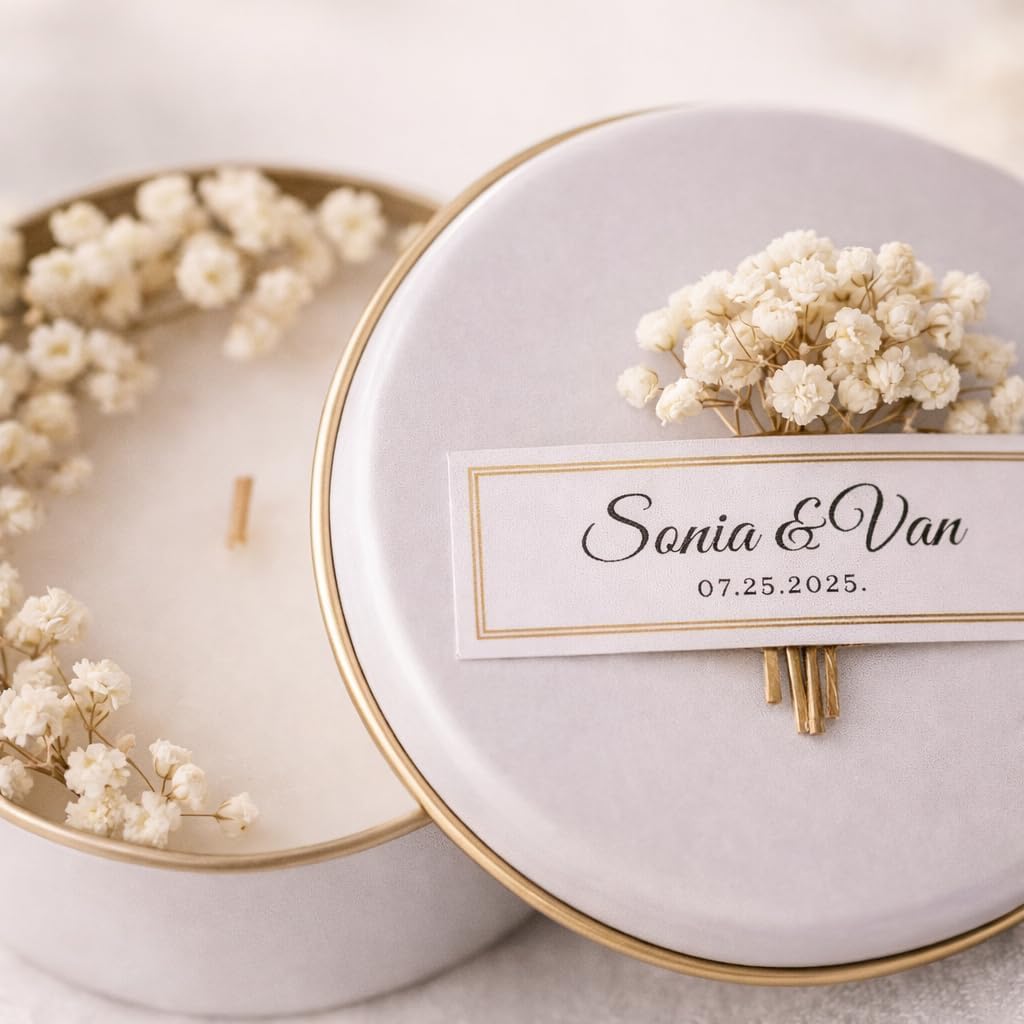
Personalized candle favors are exactly what they sound like: small candles — usually 2 to 8 ounces of scented wax in a glass vessel or tin — given to guests as a keepsake from a wedding, shower, or celebration. The “personalized” part covers a wide range: a custom printed label with the couple’s names, a wax seal pressed into the top, dried flower petals embedded in the candle, or a bespoke scent blended specifically for the event. If you’re new to this category, the appeal is immediate — candles are functional, they smell beautiful, and they travel home in a guest’s bag instead of a trash can. If you’ve already priced a few vendors and found yourself drowning in options, minimums, lead times, and upcharges, this guide is the decoder ring.
By the time you finish reading, you’ll know exactly which customization tier makes sense for your headcount and timeline, what the per-unit math looks like at each level, and how to spot a vendor whose quality matches their promises.
| EDITOR'S PICK[Personalized Natural Soy Wax We…](https://www.amazon.com/dp/B0C37NGXY9?tag=greenflower20-20) | Mid-tier[White Rose Petal Soy Wax Candle…](https://www.amazon.com/dp/B0C8GPN83W?tag=greenflower20-20) | Budget pick[Personalized Candle Wedding Fav…](https://www.amazon.com/dp/B0D4YX2R57?tag=greenflower20-20) | |
|---|---|---|---|
| Capacity | 10 Pieces | — | 10-20-30-40-50-100 Bulk Options |
| Material | Natural Soy Wax | Soy Wax | Soy Wax |
| Container Type | — | — | Elegant Tin Gift |
| Scent | — | Rose | — |
| Price | $54.99 | $47.99 | |
| See on Amazon → | See on Amazon → | See on Amazon → |
Why Candle Favors Perform — and Where They Break Down
The data here is worth anchoring to before you commit budget. The Knot’s 2025 Real Weddings Study found that edible favors and candles consistently rank among the top three categories guests report keeping after an event, with candles outperforming items like seed packets and custom koozies in longer-term retention — meaning guests are still using them weeks later.
Brides magazine, in their roundup of favors guests actually keep, specifically calls out custom candles in the 4-to-6-ounce range as the “sweet spot” between cost and perceived value: substantial enough to feel like a real gift, small enough to fit in a clutch or welcome bag without adding weight anxiety.
That’s the upside. The downside is equally clear across reviewer and planner communities: candle favors fail when the scent is overwhelming at room temperature (a problem with low-quality fragrance oils that off-gas too aggressively before the candle is even lit), when the label printing is visibly cheap, or when the vessel looks generic. A $6 candle in a plain tin with a computer-printed sticker reads as an afterthought. A $14 candle in a matte glass vessel with a foil-stamped label reads as a considered gift. The difference in guest perception is disproportionate to the difference in cost.
The tradeoff to name explicitly: customization adds cost in two currencies — money and time. The more bespoke the candle, the longer the production window and the higher the per-unit price. Every customization decision is a negotiation between budget, aesthetic ambition, and your actual timeline.
Decoding the Three Customization Tiers
Tier 1 — Custom Label on a Stock Candle ($6–$14 per unit)
This is the entry point for most couples and hosts. A vendor — typically an Etsy artisan or a mid-size direct-to-consumer brand — pours candles in their standard scent library into their standard vessel, then applies a label you’ve customized through a digital template. You choose fonts, colors, names, and a short phrase or date. The candle itself is not unique; the label is.
What you get: Consistent scent quality (assuming you order a sample first), predictable pricing, and short lead times — typically 2 to 3 weeks from proof approval to shipment. Minimum order quantities (MOQs) at this tier usually run 24 to 50 units.
What you give up: The candle is not distinctive in form. Guests who receive favors from multiple events in a season may recognize the same vessel in a different label. Scent selection is limited to whatever the vendor already produces.
Where it breaks down: Label printing quality varies dramatically. Look specifically for vendors who offer foil or letterpress label options rather than standard digital print — the tactile difference is immediately legible to guests, and Martha Stewart Weddings has consistently highlighted foil-label candles as elevating the perceived tier of the entire favor category.
Tier 2 — Dried Flower and Botanical Inclusions ($15–$28 per unit)
This tier is where the category gets genuinely interesting — and where most of the buyer confusion lives. Dried flower candles embed botanicals (lavender buds, rose petals, chamomile flowers, eucalyptus) directly into the wax. Some artisan vendors layer the flowers decoratively on the surface; others suspend them through the wax column for visual depth.
What you get: A candle that functions as a small piece of décor before it’s ever lit. Town & Country’s coverage of 2025 luxury favor trends specifically flags dried-botanical candles as the format most likely to be displayed rather than consumed — meaning your favor doubles as shelf décor in a guest’s home, extending its brand impression.
The honest tradeoff: Botanical inclusions are technically demanding. Dried plant material embedded in wax can smolder or produce smoke when the candle is lit, particularly if the vendor is using lower-temperature wax that doesn’t fully encapsulate the botanicals. This is a known issue in the category — reputable vendors address it by placing florals only in the decorative outer layer of the candle or in a non-burning ring, not in the direct wick path. Always ask the vendor explicitly: “Are these botanicals positioned outside the burn path?” If they can’t answer that question clearly, move on.
Production lead times at this tier extend to 3 to 5 weeks because of the additional hand-finishing labor. MOQs are typically 12 to 30 units, since the work is more artisanal.
Tier 3 — Bespoke Scent and Vessel ($30–$75+ per unit)
This is the territory of custom fragrance blending and proprietary vessel selection. A handful of luxury artisan candle studios — and the branded gift lines of established names like Voluspa’s custom corporate program — offer true bespoke development: you work with a perfumer or fragrance consultant to create a scent that doesn’t exist in any catalog. The vessel is often chosen or commissioned to match a specific aesthetic. Labels at this tier are typically letterpress, foil-stamped, or hand-calligraphed.
By the numbers:
| Tier | Per-Unit Range | Typical MOQ | Lead Time |
|---|---|---|---|
| Custom label, stock candle | $6–$14 | 24–50 units | 2–3 weeks |
| Dried botanical inclusion | $15–$28 | 12–30 units | 3–5 weeks |
| Bespoke scent + vessel | $30–$75+ | 24–100 units | 6–14 weeks |
The premium tier requires the most lead time because scent development alone typically takes 2 to 4 weeks of iteration before production begins. If your event is fewer than 10 weeks out, this tier is effectively off the table unless a studio already has a near-match in development or offers a semi-custom program (modifications to an existing scent rather than a ground-up build).
Lead Times: The Most Common Budget Killer
This deserves its own section because it’s where deals go wrong. Lead time anxiety is real, and it compounds: vendors in the candle category often quote production lead time separately from shipping lead time. A vendor who says “three weeks” may mean three weeks to ship from their studio — add another 5 to 7 business days for ground transit, and suddenly your 4-week window is a 5-to-6-week requirement.
Practical rule: Add 7 to 10 business days to any vendor-quoted lead time before you plan against it. Then add another week as buffer against label proof revision cycles — most customization orders require at least one round of proof changes, and that exchange adds 2 to 5 days.
For events happening before late summer 2026, vendors who serve the wedding market will start their seasonal surge in May and June. Artisan studios on Etsy and small direct-to-consumer brands frequently push lead times out by 1 to 2 weeks during peak season. Orders placed in May for a September event are generally safe; orders placed in July for a September event may need to escalate to a vendor with in-stock production capacity.
The question to ask every vendor before you commit: “What is your current production queue, and what date would you need my proof approved to guarantee delivery by [your target date]?” Document the answer in writing. Verbal lead-time quotes are not binding; written confirmation is.
Scent Selection: The Decision That Outlasts the Event
Scent is the most personal element of a candle favor, and it’s the one most frequently underweighted in the buying decision. Guests will associate your chosen scent with the event — which is either a powerful emotional asset or a liability if the scent is polarizing.
The guidance from aggregated planner experience, reflected in coverage by both Brides and Martha Stewart Weddings, points toward a consistent principle: favor clean, widely approachable scents over distinctive or complex ones. Fresh florals (peony, lily, white rose), light woods (sandalwood, cedarwood), and soft citrus (bergamot, yuzu) perform well across demographics. Heavy musks, tobacco, leather, and heavily spiced scents produce strong negative reactions in a meaningful minority of guests.
If you’re in a mid-tier or premium program with scent options, request samples of your top two or three choices before finalizing. Send samples to two or three people whose taste you trust and who are representative of your guest demographic. This step costs almost nothing and eliminates one of the highest-regret decision points in the category.
If X, Then Y — The Decision Framework
Here’s where this lands in practical terms:
If your event is fewer than 5 weeks out: Tier 1 only. Focus on finding a vendor with in-stock wax production and fast digital label printing. Do not negotiate on lead time with a botanical vendor — they’ll miss your date.
If your event is 6 to 10 weeks out and your budget is $10–$20 per unit: Tier 2 is viable if you move on vendor selection within the next week. Get proof approval done in 48 hours, not 5 days.
If your event is 12+ weeks out and your budget is $25+ per unit: You have the timeline and the budget for bespoke. Reach out to two or three luxury artisan studios and ask specifically whether they offer semi-custom scent development — it’s faster and less expensive than ground-up, and the output is still meaningfully differentiated.
If your per-unit budget is under $10: The candle category is not the right fit. Redirect budget toward seed packet favors or personalized stationery, which deliver stronger perceived value at that price point.
If guests include a significant number of people with fragrance sensitivity: Consider a visual-forward approach — a decorative, unscented botanical candle or a wax melt design that guests can choose whether to use. Voluspa and a number of artisan Etsy studios offer unscented vessels on request.
The candle favor category rewards buyers who treat the decision like a small procurement exercise: confirm specs in writing, order samples before committing to quantity, and build real lead time into your calendar rather than optimistic lead time. Do those three things and you’ll avoid the failure modes that most first-time buyers encounter. Do them with budget clarity, and you’ll end up with a favor that guests genuinely keep.